- AI Transformation
- Services
- Works
Other projects
AI Learning PersonalizationSmart content recommendationsHotel AI ConciergeAI assistant for hotel guestsClaims Documentation AutomationPlatform for faster claims processingAI for Candidate ScreeningSmart HR efficiency boosterAI Voice AgentAI agent for hands-free learningLLM Legal SummarizationEfficient and fast legal summariesVision-Based Driving AssistanceReal-time threat detection system - Company
Yellow in Numbers
$2.1B+
Value generated through AI innovation47
Custom LLMs and AI agents deployed30M+
Engaging with products we created98%
Projects delivered within agreed budget


Key Facts
Legacy limitations: Traditional rule-based chatbots don’t do well when it comes to intricate queries, lack memory, and cannot execute autonomous actions.
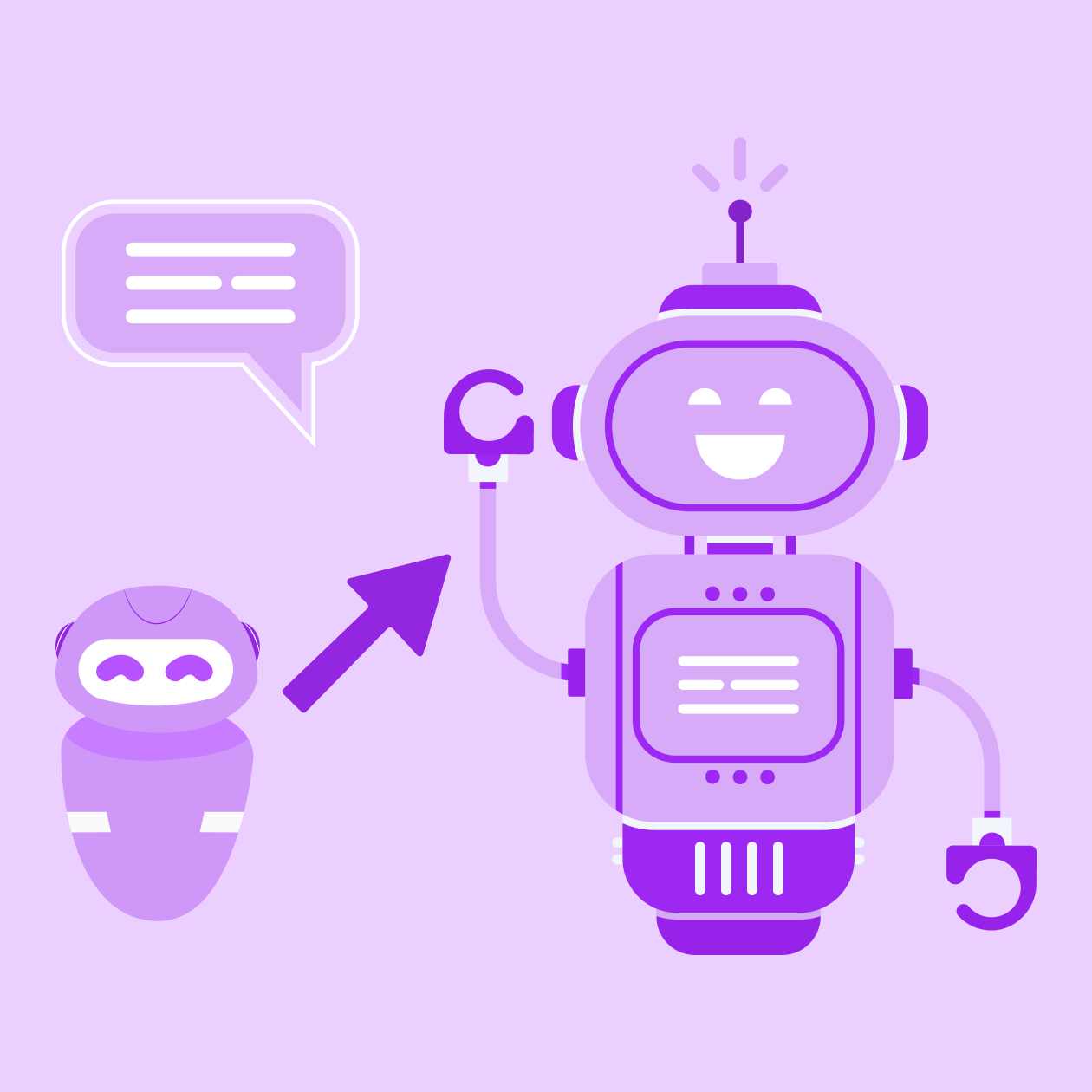
The agentic shift: AI agents differ from chatbots by using integrations, reasoning, and memory to perform end-to-end business workflows.
Implementation roadmap: A successful move requires a strategic 6-week plan, focusing on orchestration, RAG integration, and testing.
Business impact: Replacing static bots with their smarter counterparts drives higher resolution rates, proactive service, and deeper personalization.
In the early days of tech-enabled customer service, simply having a chatbot somewhere on your website felt like a sci-fi dream. It could greet visitors, deal with queries, and route tickets to humans when necessary. But as customer expectations have skyrocketed, those rigid, script-following bots have started to feel like annoying mosquitoes.
Today, automated conversation is a bare minimum. Automated action is what you are truly looking for. This is the era of replacing chatbots with AI copilots. Unlike their predecessors, AI agents deal with problems head-on, keep the history of former interactions, and autonomously execute tasks across other tools.
If your organization is still relying on a decision-tree bot that gets stuck in "I don't understand" loops, you are leaving customer satisfaction and your business realization on the table. This guide shows why 2026 is the year to upgrade your infrastructure and how to develop a tailor-made AI agent assembled to truly work for your business goals.
Upgrade your customer experience with our development services.
Why Transition from Legacy Chatbots to Smart Agents in 2026?
The difference between these two technologies is fundamental. A traditional chatbot is often a "stateless" interface. It deals with one input at a time without retaining context or digging deeper into the goal. It waits for a keyword to trigger a pre-written response. By contrast, a smart agent is autonomous and goal-oriented. It perceives its environment, reasons about how to solve a problem, and takes action to get to desired results.
In 2026, the technology supporting these copilots has truly matured. Orchestration frameworks like LangChain and LlamaIndex have standardized how assistants handle data connections. LLMs have become faster and cheaper, and, as a result, "synthetic" reasoning has become accessible for real-time applications.
Transitioning to agentic systems is a must for present-day businesses. Customers now expect hyper-personalized experiences. They expect a bot to know what they ordered before, understand that their flight was delayed, and offer a rebooking solution without asking. A simple reciting of a refund policy doesn’t cut it anymore. Only an agentic architecture can deliver this level of service.
Step-by-Step Transition Guide
So, how can you do it? Moving from a rule-based chatbot to a sophisticated assistant requires careful planning. Writing scripts is gone. You are now engineering a software system capable of thinking on its own.

1. Estimate the Existing Limitations of Your Legacy Chatbot
Before building the new, you must diagnose the old. Analyze your current chatbot's conversation logs. Analyze "fallback" frequency (the number of bot’s fails). Identify the specific user intents that frustrate people.
Common limitations usually include:
Lack of integration: The bot can explain how to change a password, but can't actually do it.
Amnesia: The bot requires the user's account number four times in one conversation.
Rigidity: If the user phrases a question differently from the way the training data says it should sound, the bot fails.
2. Choose a suitable AI Agent Platform and Framework
Analyzing and picking the tech stack is an important part of your upgrade. You need a foundation that supports orchestration that controls how the agent decides which step to take next.
You might choose cloud-native tools like Vertex AI Agent Builder by Google or Amazon Bedrock to get a more stable infrastructure. Alternatively, open-source frameworks provide flexibility for engineers building custom logic. Key choosing criteria include:
Orchestration capabilities: Can it manage complex/multi-step workflows?
Model flexibility: Can different LLMs (like GPT-4, Claude, Llama 3) be swapped depending on the task difficulty?
Security: Are there any built-in compliance features for sensitive data?
3. Design and Develop Your Custom AI Agents
Well, this is where the engineering happens. Unlike chatbots defined by linear flowcharts, agents are defined by their "tools" and "instructions."
You will define a system prompt, a hidden instruction for your agent to set its persona and boundaries. Then, you add APIs to it to help them interact with your CRM, booking engine, or any other tool you use. The agent uses reasoning to decide when to turn to these tools. It may go like this: If a user writes, "Where is my order?", the agent understands the intent, calls the "CheckOrderStatus" tool via API, gets the data, and gives a human-like response to them.
Unlike legacy bots, your agent's instruction set includes routines for multi-step workflows and fallback responses if the assistant can’t complete the task properly. More advanced agents can even do stuff proactively, like suggesting new products or upselling services.
4. Train Your Assistants with Specialized Knowledge
An agent is only as good as the information it can access. This is where you need Retrieval-Augmented Generation (RAG). Instead of hard-coding answers, you connect the agent to your knowledge base (PDFs, internal wikis, product manuals).
However, you must implement guardrails to anticipate instances where the AI confidently invents incorrect facts, commonly known as hallucinations. Best modern practices include:
Citation mode: Forcing the agent to cite the specific document chunk it used to write an answer.
Data cleaning: Seeing if the source material is up-to-date and free of conflicting information.
AI-based data training: Using AI-generated (synthetic) scenarios to stress-test the agent's reasoning capabilities before it faces real customers.
And don’t forget about prompt engineering. System, human, and assistant messages must be tuned for the same policies, tone of voice, and level of readability. Complex workflows may need dynamic prompt construction to operate through a changing environment and knowledge base updates.
5. Rigorously Test All AI Agents Before Deployment
Testing an agent is harder than testing a chatbot because the former is non-deterministic. Testing if Input A leads to Output B is not enough. You need to evaluate the whole process.
Start with scenario-based testing to see if the agent can assemble the right workflow steps for any goal. Unlike bots, agents use reasoning flows, which means you must test both common and rare user behaviors. Also, deploy pen testing to fake hackers who may or may not try to abuse/trick the assistant. That way, you will check if your security guardrails and boundaries stand up when threatened.

Finally, workflow simulation is essential. Does the agent complete the full process chain when given ambiguous/conflicting instructions? Can it handle mid-conversation intent changes? If integrations break, does the agent recover or escalate?
6. Deploy, Check, and Upgrade Performance
Once deployed, the work isn't done. You need an "orchestrator" or supervisor layer that will watch conversations in real-time. If an agent struggles to complete a workflow, the system should seamlessly hand off the dialog to a REAL person.
Look at things like "the goal completion percentage" rather than "response time." Is the agent actually solving the user's problem? Use the reports to rework the system prompts and/or change the knowledge base.
As your smart agent matures, consider running compliance audits and hallucination stress tests from time to time. Don’t forget to include the simulation of new regulatory scenarios or outside database integration. Ongoing optimization will help your agent continue to deliver business value over time.
Need a custom AI solution? We’re here to help!
What Custom Agents Can Do That Chatbots Simply Can't
The gap between a bot and an agent is pretty huge once you learn how both function. Here is what that difference looks like in practice.

1. Executing End-to-End Business Processes
A chatbot provides information, and an agent does the work. If a customer wants to return a product, a chatbot links them to the returns policy. A smart agent creates the return label, schedules the courier pickup, updates the supply database, and processes the refund. The whole lifecycle in the chat. The ability to talk with the backend side transforms support into a true productivity engine.
2. Managing Stateful, Multi-Step User Journeys
Complex requests rarely happen in a single turn. They require back-and-forth dialogue to gather information. And intelligent agents really can maintain the context. If a user is applying for a loan, the agent remembers the income figure provided five minutes ago and applies it to the debt-to-income calculation later in the conversation. It manages the workflow dynamically, adapting if the user jumps between topics.
3. Utilizing Long-Term Memory for Personalization
Standard chatbots usually reset their "brain" after every session. More cutting-edge AI agents use distinct memory layers. They have short-term memory for the current conversation and long-term memory to keep user preferences and dialog history.
If a customer returns three months later, the agent can say, "Welcome back, Chloe. Did that espresso machine work out for you?" Such deep personalization builds deeper brand loyalty and customer confidence in a way that generic if-then scripts never can.
4. Securely Interacting with Tools and APIs
Now this is the true superpower of the new agentic approach. Through structured "function calling," agents can become interpreters between code and language. They can query a SQL database, update a Jira ticket, or send an email via SendGrid.
Please note that this is done with the strictest access authorization. The assistant doesn't wander the systems without any supervision. It can only get access to the allowed API endpoints. Strict guardrails and fine-tuned access permissions guarantee these interactions are always compliant, auditable, and resilient to threats.
5. Delivering Definable Business Outcomes
Because agents can do actual work, their ROI is easier to measure. You can track exactly how many refund requests were fully automated, how many sales appointments were booked without human intervention, and how much time was saved per interaction. This moves the metric from "conversations handled" to "business value generated."
How to Get Started: A Practical 6-Week Implementation Plan
Unfortunately, replacing chatbots with agents doesn't happen in seconds. It just physically can’t. Here is a practical timeline that will make sense for your team.

Week 1: Define Scope, KPIs, and Processes
Don't try to boil the ocean. Pick one high-value use case—like "Order Modification" or "IT Password Reset." Map out the ideal workflow step-by-step. Conduct deep process mapping—interview stakeholders, write down every action, and chart the current user journey. Set specific success metrics: Is your goal to reduce human escalation by 30%? Or reduce answer time by 50%?
Weeks 2–3: Build a Prototype with Core Logic
Assemble a cross-functional project team that includes software developers, AI engineers, business analysts, and process owners. Develop the core agent. Set up your orchestration framework and connect the LLM of your choice. Apply the RAG pipeline for the copilot to get responses directly from your documentation. By the end of week 3, you should have a "brain" that can provide answers and logically decide when to use a tool.
Week 4: Test Real Integrations and Agent Orchestration
Replace all filler connections with the live tools. Verify that the agent can reach your APIs and doesn’t mull over errors for too long. If the API malfunctions, does the agent give an apology and try again, or does it crash? Test the way orchestration works to identify if the copilot enters infinite loops.
Week 5: Run a Pilot Project with a Controlled User Group
Release the agent to a small segment of users (5% of traffic or internal employees will do). Provide clear flows for issue reports. Monitor every interaction and track hallucinations, since no smart tool is safe from them. Refine the guardrails and prompt instructions based on real-world usage data.
Week 6: Analyze Results, Check ROI, and Plan Scale
At the close of the pilot, conduct a comprehensive review of the pilot data against your metrics. Did the agent successfully complete the tasks? What do users think about it? If the results are positive, plan the rollout to the wider audience. If not, change the logic behind the reasoning and the definitions of the tools.
Build your artificial intelligence solution with Yellow!
Conclusion
AI agents and AI chatbots look almost the same to the untrained eye, but shifting from one option to another is inevitable for companies that want to stay afloat. In 2026, technology allows for systems that listen, think, and act. By replacing chatbots with AI agents, you are upgrading not only software but also the way you talk to your customers. You are changing from a reactive support model to a proactive, intelligent engagement that saves time and drives value.
Still, the change needs deliberate planning at every step. Choosing orchestration frameworks, building secure knowledge pipelines, deploying solid guardrails—all that requires plenty of effort. But the destination—an intelligent workforce that works 24/7 and makes your business grow—is worth it.
Got a project in mind?
Fill in this form or send us an e-mail
How can I decrease support ticket numbers and escalation rates with the help of smart agents instead of traditional chatbots?
What is the best platform to upgrade a legacy rule-based chatbot into an agent for my business?
What tool should I use to build and launch AI agents for personalized support?
Subscribe to new posts.
Get weekly updates on the newest design stories, case studies and tips right in your mailbox.