- AI Transformation
- Services
- Works
Other projects
AI Learning PersonalizationSmart content recommendationsHotel AI ConciergeAI assistant for hotel guestsClaims Documentation AutomationPlatform for faster claims processingAI for Candidate ScreeningSmart HR efficiency boosterAI Voice AgentAI agent for hands-free learningLLM Legal SummarizationEfficient and fast legal summariesVision-Based Driving AssistanceReal-time threat detection system - Company
Yellow in Numbers
$2.1B+
Value generated through AI innovation47
Custom LLMs and AI agents deployed30M+
Engaging with products we created98%
Projects delivered within agreed budget


The conversation around artificial intelligence has shifted dramatically over the past several years. We have moved well past the initial excitement of chatbots, simple recommendation systems, and image generators. Now, we enter a more pragmatic and mature phase, where businesses are asking hard questions about ROI, scale, and the operational impact of AI.
This article is a review of the key highlights from our recent webinar, where we explored how companies are moving from theoretical experiments to deploying AI in production environments that drive revenue and efficiency.
Request the full video and find more insights!
Why Real-World AI Use Cases Matter More Than AI Demos
It’s easy to be impressed by a curated demo. However, there is a gap between a demo that runs in a controlled environment and the reality of deploying AI inside a real organization. Real-world AI use cases are focused on solving real, daily, high-friction problems. It may not be glamorous, but it’s where the true value lies.
Business leaders today have moved their focus from the question "What can AI do in theory?" to "What can AI do for us right now, within our real environment?" Such an approach has underpinned a large surge in AI adoption in companies across every industry. Novelty is gone, so now decision-makers are looking for AI in real business scenarios.
Let’s make your business smarter!
From Experiments to Business-Critical Systems
It’s typical for organizations to start their AI journey with small experiments. Perhaps the marketing team uses ChatGPT for idea generation, or software teams use Copilot for code suggestions. These initial steps often bring some improvements, but they don’t really change the broader trajectory.
The transition to business-critical production systems, however, is a different challenge. It involves deeply embedding intelligent automation solutions into the company’s digital infrastructure. This shift also involves shifting from a "human-in-the-loop" configuration, where a person is required at every step, to a "human-on-the-loop" model, where oversight is strategic but not ever-present.
What Makes an AI Use Case “Real-World”
But how do you distinguish a vanity project from a high-impact solution? Real use cases share a couple of measurable characteristics that set them apart:
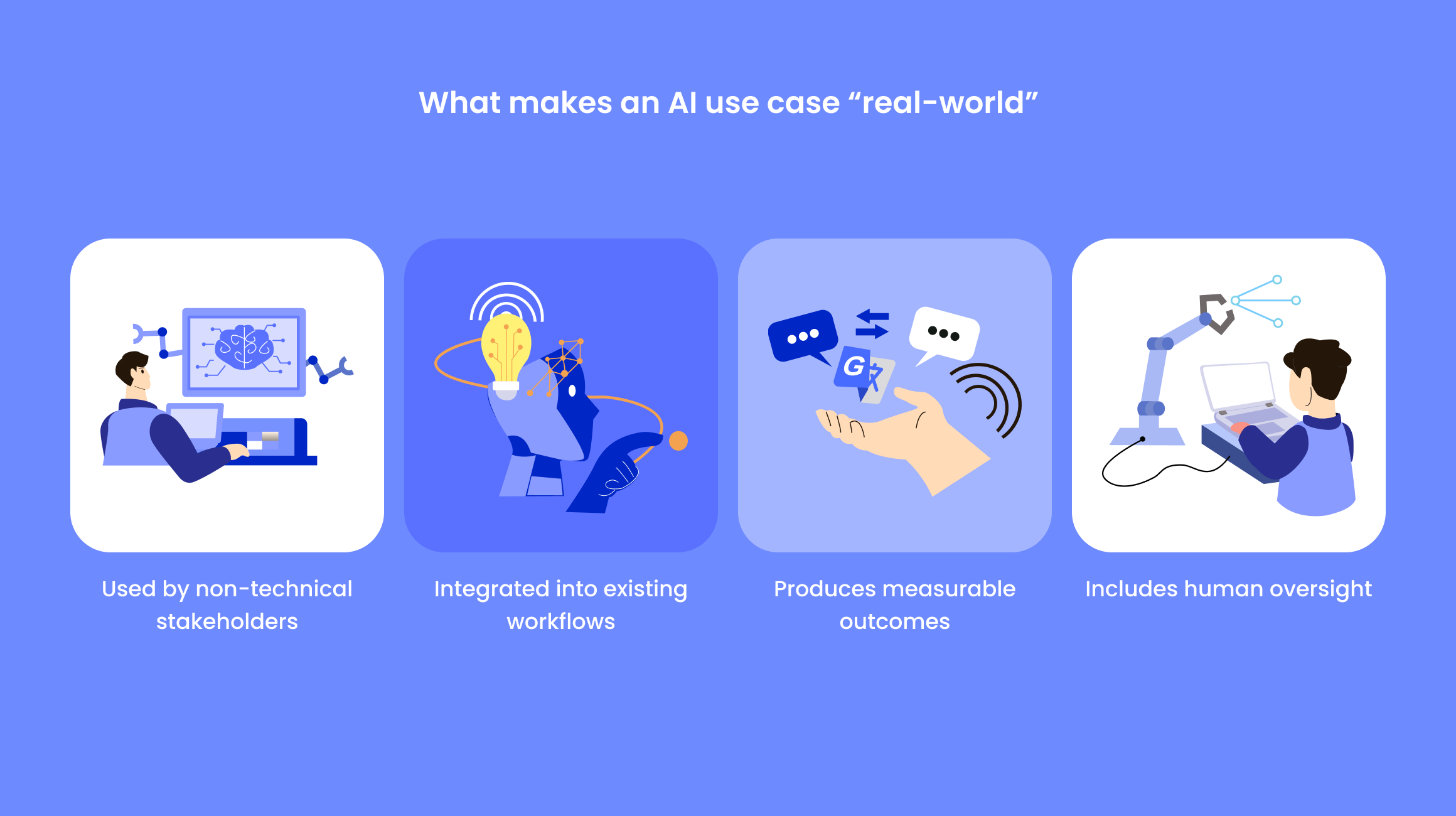
Used by non-technical stakeholders: Impactful systems are used by marketers, recruiters, project managers, and other business professionals, who may not know or care about neural networks, but need the tools to deliver results.
Integrated into existing workflows: The most practical AI applications plug into CRMs, content management systems, and other core platforms.
Produces measurable outcomes: Success is not measured in “coolness” or novelty. Rather, the best cases deliver specific results, like reducing hours on a process or improving conversion.
Includes human oversight: Automation is key, sure, but human control over critical checkpoints ensures quality and brand safety, so no "black box" problems.
These points can help you differentiate something real from something not worthy of your attention. The projects that bring value possess all of these points. And as an AI development agency, we have a couple of business examples to show off.
Use Case #1: AI-Powered Marketing Website Automation
One of the most compelling examples of AI in real business scenarios comes from Shout Out, a platform designed for collecting and embedding video testimonials. Here, the adoption of automation, beyond traditional RPA, has spotlighted how AI can shatter bottlenecks and free specialized staff to focus on what they do best. The result: unprecedented innovation in marketing speed, flexibility, and scale.

The Challenge: Marketing Velocity vs. Engineering Focus
In a typical SaaS organization, the marketing website is ever-changing: As campaigns shift or products evolve, it gets updated. Yet, in many cases, the marketing site and core product share a codebase, developer team, and design resources. When marketers want to launch a new landing page, update SEO content, or push a blog post live, the process may require a designer for the visuals and a frontend developer for the build. Every new campaign introduces more friction.
This creates an unpleasant situation. Developers, whose highest value is found in delivering features on the core SaaS application, are forced to shift focus to push changes through for the marketing team. Marketers, for their part, need to move at the speed of cultural and campaign trends, sometimes launching multiple campaigns in a single week. Waiting for the next development cycle or for internal reviews means lost opportunities. This “speed vs. control” tradeoff highlights website management pain and why organizations need truly practical AI that can reduce technical bottlenecks.
The AI-First Approach to Marketing Automation
To resolve this, Shout Out implemented a radical “separation of concerns”—placing the entirety of the marketing website outside the standard development process. Humans still maintain the React-based product app, with AI being used for tasks like code suggestions. The marketing website, in contrast, is now fully created, updated, and maintained by Lovable.
Over 70 pages, including SEO-driven landing pages, blogs, and campaign-specific microsites, exist independently from the main codebase.
Changes, which once involved tickets, sprints, and project managers, are now handled through AI-powered workflows.
A person with no engineering experience initiates updates and new campaigns through language commands, drastically reducing go-live times.
The outcomes are fascinating: Engineering teams pay more attention to the product itself (as they should), and marketing iterates and experiments with new levels of speed and freedom.
How the System Works (Non-Developer Workflow)
What makes this route both effective and quite replicable is its convenience for non-developers. Someone who has never worked with code directly can manage all parts of the site content and layout. Instead of writing specifications for a designer or waiting in development queues, the marketer interacts with a smart solution that executes tasks seamlessly:

Page creation: Type a high-level prompt (“Create a product comparison page and highlight its availability”), and the AI provides page structure, responsive layout, and creative copywriting.
Content updates: Mix SEO practices with real-time copy refinement. Need the call-to-action to be more assertive? The AI edits in seconds.
Layout and copy changes: AI takes your brand voice into account and rearranges sections, adapts visuals, and makes everything consistent, so no more endless back-and-forth.
SEO iteration: Keywords, meta-tags, and structured data are polished and adapted in seconds to changing priorities in the marketing funnel.
This represents a huge process shift where the AI doesn’t just facilitate tasks, but provides new assets for a new competitive edge and the next level of flexibility.
Business Impact and Measurable Results
The business results speak for themselves:
No content management system required: Severing the tie to a traditional CMS means lower overhead, fewer maintenance concerns, and more flexibility when business needs change.
100× faster iteration speed: Campaign ideas go live in minutes. What previously required hours of planning and development time now happens almost in real time.
Near-instant publishing: Reduced publishing windows mean that campaign opportunities can be fully seized, and fast experimentation becomes more and more widespread.
No developer/designer hours: Not a single minute of developer time is required for marketing changes, so technical resources are free for core product development.
These shifts translate to higher marketing ROI, more campaigns being tested, and a lower risk of development/resource backlog stalling business growth.
The “Division of Labor” AI Strategy
This use case shows a critical approach: Not all business processes really need end-to-end automation. The “division of labor” method defines boundaries. In this model:
The core product remains conventionally engineered, often with AI assisting but never replacing the judgment of experienced software engineers.
The marketing site is entirely moved to automation, so teams can experiment and make changes at a speed that has never been seen before.
By adopting a balanced philosophy wisely, organizations avoid the issue of attempted “AI everywhere,” which often results in fragile systems and unexpected risks/threats. This approach to AI-driven decision-making demonstrates how a balanced mix of automated and manual work truly aligns technology with what your business needs.
Use Case #2: Agentic AI for Project Estimation and Scoping
Marketing automation is visible and immediately relatable, but some of the most potent AI use cases in business happen “behind the curtain.” One of the more advanced developments is the introduction of smart agentic systems for project estimation and scoping.
The Original Process (Before AI)
Consider a custom software agency that receives a request to scope and estimate a new platform. The initial process usually looks like this:
Necessary but time-consuming communication: Stakeholders, architects, managers, and analysts coordinate through multiple meetings/emails and clarification cycles to stay on the same page with each other when it comes to goals and requirements.
Competent but personnel-heavy analysis: Subject-matter experts review business needs, prepare the necessary documentation, and iterate on technical + executive-level summaries to guarantee accuracy and shared understanding.
Thorough but resource-intensive process: Because the process relies a lot on experienced professionals, it becomes a weighty investment of time and effort. And still, some things may only surface later in delivery, so scope/timelines can change anytime.
This approach is based on careful planning and decision-making, but it can also extend sales cycles, slow onboarding, and require highly skilled teams to spend a lot of time on the same tasks over and over again.
Introducing an Agentic AI System
For things to go faster, we have implemented a system of smart agents. Unlike simple chatbots or single-purpose assistants, agentic models include multiple agents (each with the relevant expertise and role) communicating and working together toward a comprehensive solution. Agentic AI is not really about just “talking to the robot” and is more about manufacturing an AI-led team, where virtual agents act much like their human counterparts and run more intricate pieces of the work. By orchestrating tasks and overseeing each other's output, these systems successfully imitate the division of roles in a human team without jeopardizing the decision-making quality.
The Three-Agent Orchestration Model
Our orchestrated system is structured as follows:

Business analyst agent: This agent deals with client inputs, clarifying requirements, expanding initial unclear ideas into functional requirements, and performing competitive research. It drafts proposal documents that usually require hours of team focus and attention.
Architect agent: Once everything is clear, the architect agent determines the technical path. It investigates technology stacks, produces architectural diagrams (from C4 to low-level), and outlines the API layer.
Project manager agent: Building on the technical plans, this agent creates implementation roadmaps, sprint timelines, resource estimates, and even pre-populated Jira tasks, tailored for agile workflows.
Input Evolution: Clients Now Arrive AI-Prepared
Another effect of rapid artificial intelligence adoption in companies is the evolution of client inputs. Increasingly, new clients are “AI-prepared”—they’ve already shaped their requirements, features, and user stories with ChatGPT or a similar generative model before the first human meeting. Such pre-work brings the client vision way closer to the final delivery roadmap, so the first meetings become more business-focused and less administrative. It also signals the start of AI-to-AI collaboration, where one agent is preparing requirements, and another is transforming those requirements into ultrapractical results.
Time Savings and The Quality of Output
Such an approach brings measurable impact:
Process compression: What previously could stretch over days now takes 15–30 minutes from initial request to preliminary scoping documentation.
Output richness: The deliverables include comprehensive executive summaries, technical diagrams, fully outlined timelines, Jira board tasks, and boilerplate repositories.
Consistency: Using models managed by repeatable prompts/constraints helps the system provide outputs with a predictable level of detail.
Managing AI Hallucinations and Risk
Still, no powerful system comes without any drawbacks. AI can hallucinate, invent facts that don’t exist, or make leaps of logic unsupported by the data. To keep automation both safe and effective, high-fidelity controls are a must:
Detailed system prompts: Providing the agents with extensive instructions (sometimes up to 2000 lines) helps them keep an exact understanding of the context and stick to their roles.
Clear role boundaries: Business logic remains with the business analyst agent, while technical architecture is the domain of its own agent, each with strict permissions.
Mandatory human verification: No output is delivered without human examination. People remain the judges and final gatekeepers, so AI-driven decision-making becomes reliable and transparent.
This approach verifies that real-world AI should support human expertise and knowledge, not replace it completely.
Some Tech Insights
Embracing practical AI cases in real-world settings revealed several tech-related things that affect even the most well-resourced organizations.

Token Limits Are No Longer the Bottleneck
Historically, context windows were a core technical constraint. Today, new models can go way beyond 200,000 tokens (which is a lot). This change helps AI process lengthy project specs, chat histories, entire codebases, or multi-month design docs in one go. Also, larger token limits provide new opportunities for agentic systems that use shared memory and reference a wider range of documents. As a result, businesses get more intelligent automation solutions and decisions based on a more comprehensive perspective.
Why AI Still Takes Time to Generate
Despite breathtaking advances in speed, producing polished outputs can still take longer than traditional software processes because of the way auto-regressive generation works. These models give answers using one token at a time, building their reasoning step by step and double-checking their own logic. That can make things slower for more complex workflows, like project scoping or multi-agent collaboration, but it also leads to more reliable results than older approaches.
Infrastructure of AI Systems
The compute load required to run high-performance AI is managed by providers (Anthropic, OpenAI, and others). Organizations don’t need to buy costly on-premise infrastructure to use top-tier models for their AI projects. A cloud-native approach brings scalability, flexibility, and manageable cost curves, so even small and mid-sized businesses can access AI.
Transform your business with artificial intelligence now!
What These AI Use Cases Teach Businesses About AI Adoption
Real-world results provide important lessons: The greatest returns come from strategic implementation, not tech for tech’s sake. Successful businesses start by outlining their processes and asking, “Where does human expertise add the most value? Which tasks are prone to errors, limiting, and/or repetitive?” By automating the latter (with human managers in mind), businesses direct human creativity and power to areas that matter most.
For websites, AI automates operations, and people focus on strategy and branding.
In automated project scoping, AI speeds up the conversion of fuzzy goals to detailed, development-ready documents, while experts review and polish.
Whatever the scenario is, AI definitely moves from handling low-level process management to getting more substantive work done.
What’s important, though, is that successful AI initiatives avoid both extremes: neither “AI everywhere at all costs” nor “AI nowhere.” They identify agentic AI systems that support complex, multi-role environments, but preserve a human-check step whenever critical outcomes are at stake.
Final Thoughts
We are witnessing the transition of artificial intelligence from novelty and hype to essential business utility. Across all sectors and business sizes, organizations are using AI not as a funny add-on but as a core operational layer. Whether it’s website management without a single line of code, or automated project scoping executed collaboratively between multiple virtual agents, these technologies are now ready for prime time.
Got a project in mind?
Fill in this form or send us an e-mail
What industries benefit the most from real-world AI use cases today?
How do companies avoid over-automating processes with AI?
Is agentic AI suitable for small and mid-sized businesses, or only enterprises?
Subscribe to new posts.
Get weekly updates on the newest design stories, case studies and tips right in your mailbox.