





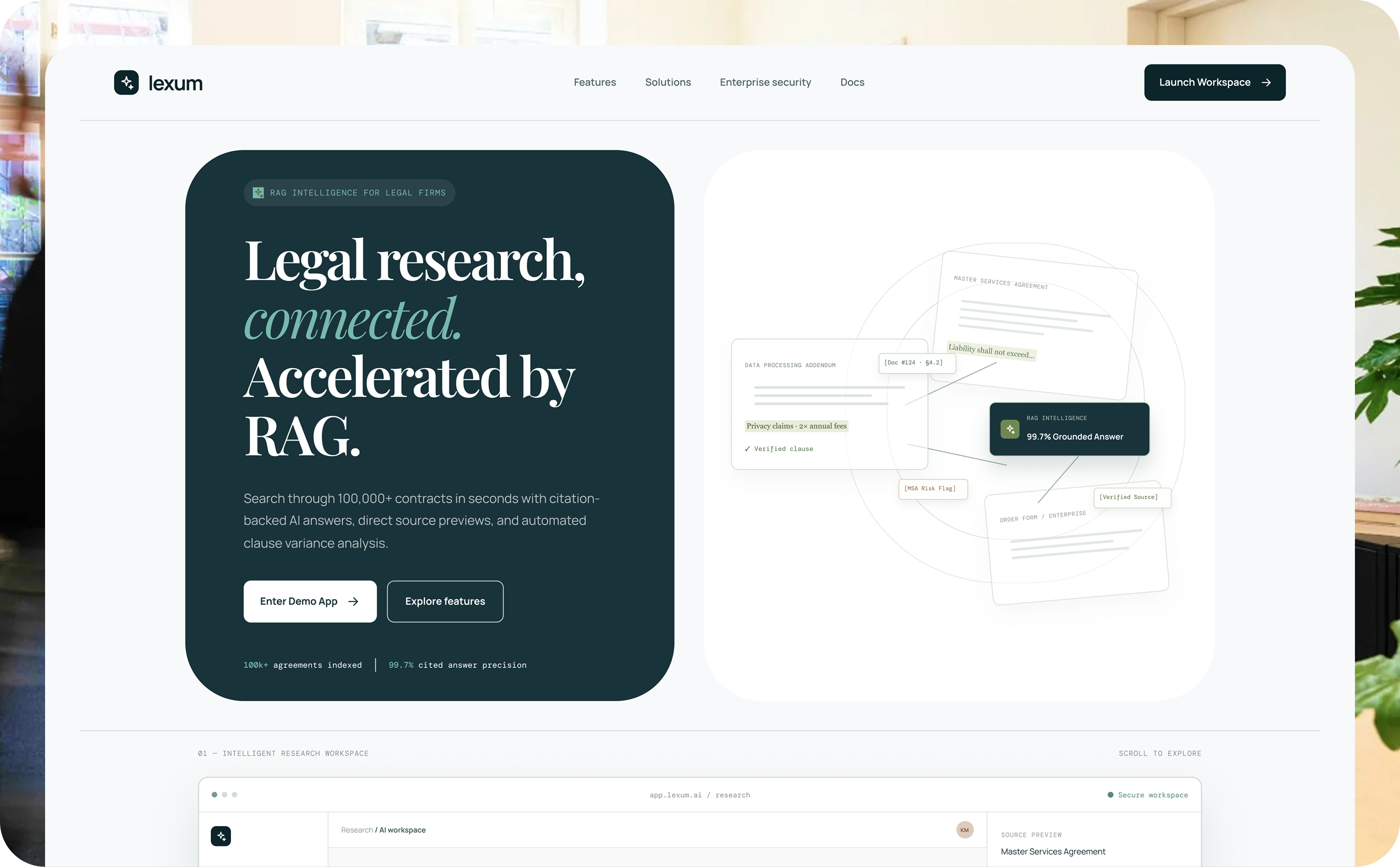
RAG Intelligence Platform for a Legal Firm
Processed and indexed over 100,000 legal documents to reduce legal research time by 58%
Legal Services
2-months MVP development & 6-month monitoring + adjustment
58% less time on legal research

58% less time spent on legal research
The RAG-powered platform reduced the time legal professionals spent researching contracts, clauses, and precedents by 58%.
94% retrieval accuracy
The platform achieved 94% retrieval accuracy on internal evaluation datasets, so the legal teams can find relevant information across a large document repository.
72% less time locating precedents
Semantic search and automated document indexing reduced the time needed to identify relevant legal precedents and documents.
89% user adoption
The platform reached 89% adoption within the first three months, bringing AI-powered document search into everyday legal workflows.
About the project
A US legal services firm managed over 100,000 contracts, amendments, and legal documents across multiple practice areas. Attorneys and paralegals spent a lot of their time searching through document repositories to locate specific clauses and precedents.
The firm wanted to improve legal research efficiency and reduce the time spent on contract reviews and repetitive document analysis while maintaining confidentiality and compliance.
The client had
100,000+ legal documents across multiple repositories.
Slow reviews and limited knowledge access.
Need to improve productivity without increasing headcount.
We were responsible for
Building a secure RAG platform for legal document intelligence.
Automating document processing and contract analysis pipelines.
Implementing enterprise security, access controls, and private cloud deployment.

Team

To accelerate delivery, the team used a multi-agent development workflow that included AI agents for code generation, test creation, documentation, and code review. These agents automated repetitive engineering tasks so the core team could focus on architecture, legal-domain requirements, and security.
Development process
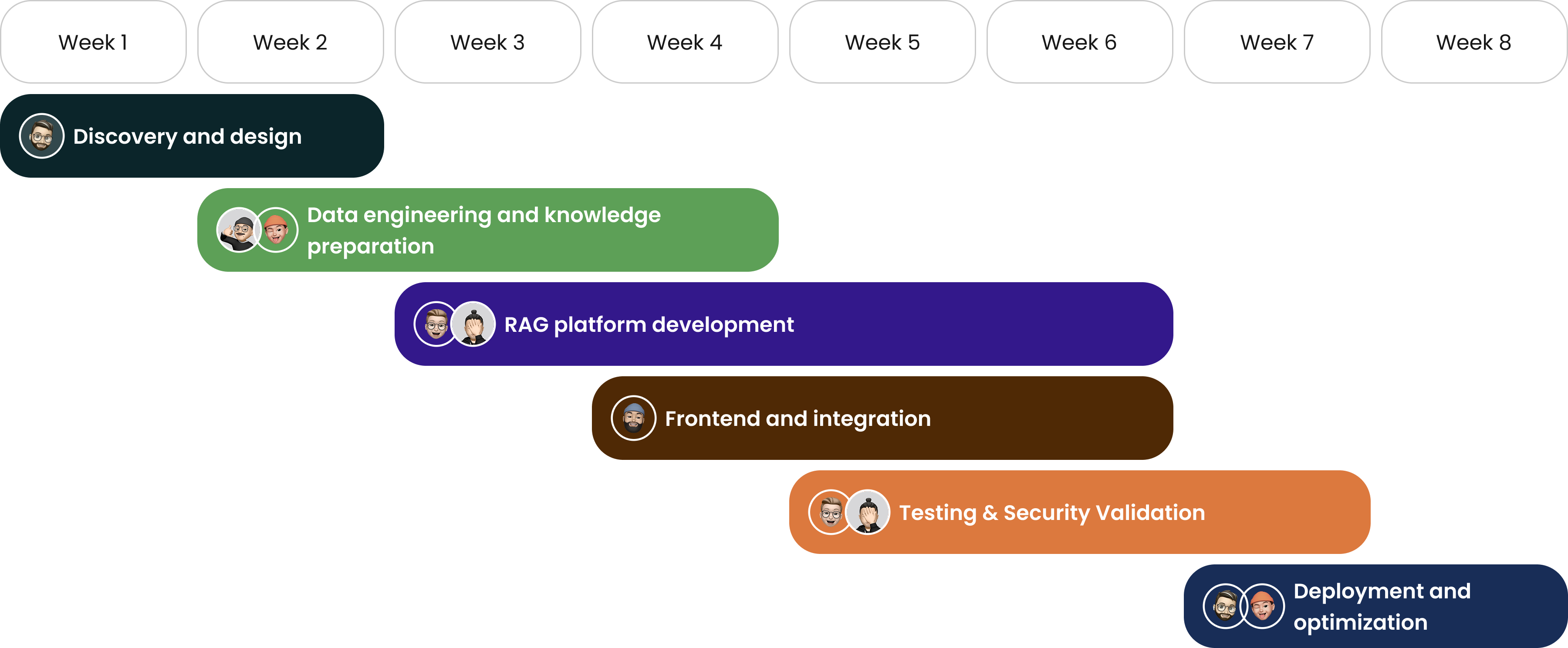
Discovery and legal workflow analysis
We interviewed legal teams to understand document workflows, review processes, compliance requirements, and common research tasks.
Data audit and knowledge base preparation
The team analyzed more than 100,000 of legal documents to define metadata standards, document taxonomies, and retention policies.
RAG architecture design
We designed a Retrieval-Augmented Generation architecture capable of retrieving relevant legal information with high precision.
AI development
The team developed document ingestion pipelines, OCR workflows, embedding pipelines, retrieval services, prompt orchestration layers, and citation verification mechanisms.
Validation and security testing
We conducted extensive testing using real-world legal scenarios to measure retrieval accuracy, hallucination rates, and security compliance.
Deployment and optimization
After deployment, we monitored and optimized the platform using evaluation datasets and user feedback from legal teams.
Project timeline
Key AI features
Things the final platform can do.
Natural-language legal search
Instead of navigating folders or using complex keyword queries, legal professionals can ask questions in plain English, and the platform retrieves the most relevant information from more than 100,000 documents in seconds.

Citation-backed RAG responses
Every answer generated by the AI is grounded in retrieved source documents through Retrieval-Augmented Generation (RAG). Responses include direct references to contracts, clauses, and document sections.

Contract clause analysis and comparison
The platform automatically identifies and compares clauses across multiple agreements, so lawyers can analyze differences in liability, indemnification, confidentiality, termination, and renewal terms.

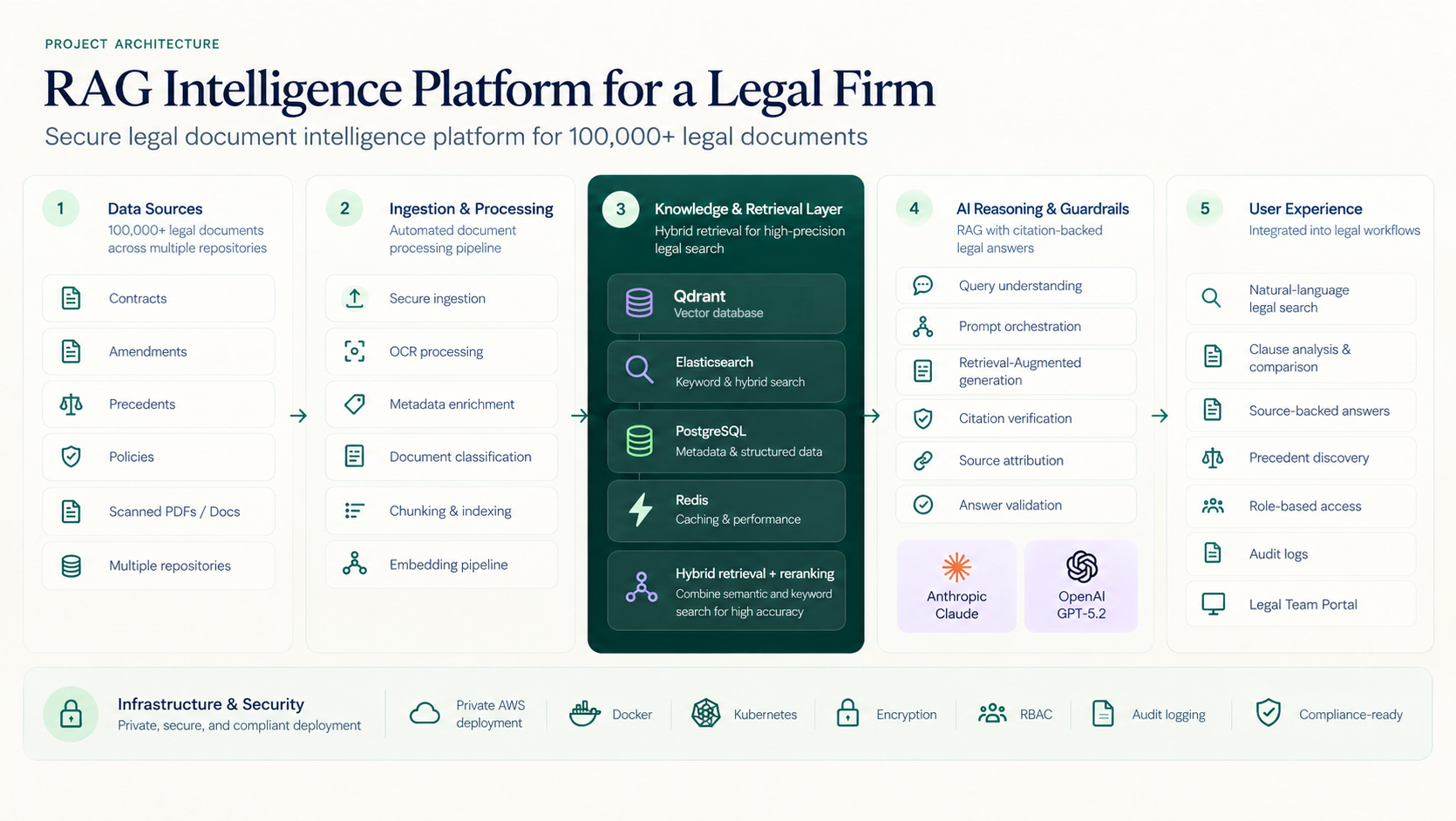

Tech stack
The technologies under the hood of the platform:
Development challenges and solutions
What we faced during the development process.
AI accuracy
Challenge: Legal professionals required highly accurate answers and could not rely on AI responses that lacked supporting evidence.
Solution: We implemented a RAG architecture with mandatory citation generation, source attribution, and retrieval validation. Every answer was grounded in retrieved documents, allowing users to verify information instantly.
Too much information
Challenge: The document repository contained contracts spanning multiple years, jurisdictions, formats, and naming conventions, reducing retrieval quality during early testing.
Solution: We developed a metadata enrichment pipeline that automatically classified documents, extracted legal attributes, and standardized indexing structures. Combined with hybrid retrieval and reranking, this improved retrieval precision by over 40%.
Result
Within six months of launch, the platform delivered measurable improvements across legal operations. By combining automated document processing, hybrid retrieval, and citation-backed AI responses, the platform now helps legal professionals locate relevant contracts and precedents, compare clauses, and access institutional knowledge without manually digging through repositories.

FAQ
What problem did the legal team face before building the platform?
How did Yellow build the legal intelligence platform?
How can lawyers use the platform in their daily work?
How does RAG improve the reliability of legal research?
How did Yellow handle the client's large document collection?
How did the platform support data security?
monthly cost.