


AI Voice Assistant for Hands-Free Learning
A voice-enabled AI tutor that improved accessibility while reducing tutor workload.

About the project
Our client had an online education platform in the USA providing remote courses. They partnered with Yellow to create a custom voice assistant to boost engagement and provide better accessibility. Problem The students were struggling to engage with online content and ask questions during lessons, and tutors spent hours answering repetitive queries. Also, the platform didn’t have enough accessibility for students with disabilities.
60% faster query creation
Average time to create and refine a query decreased from 5 minutes to 2 minutes with Claude-powered natural-language-to-SQL.
90% faster first-query generation
Users could generate an initial SQL query in about 30 seconds instead of 5 minutes using natural-language input.
50% fewer manual query steps
Claude-powered querying reduced the number of manual steps required to move from a data question to an executable SQL query by around half.
The client had
Low engagement rates in remote courses
Tutors overloaded with repetitive Q&A
Difficulty providing real-time feedback and tracking progress
Need for a hands-free tool that integrates with the learning platform
We were responsible for
Developing a custom AI voice assistant for the e-learning platform
Monitoring its performance
Maintaining its accuracy and effectiveness

Team
To realize the client’s vision, we have allocated the following team:

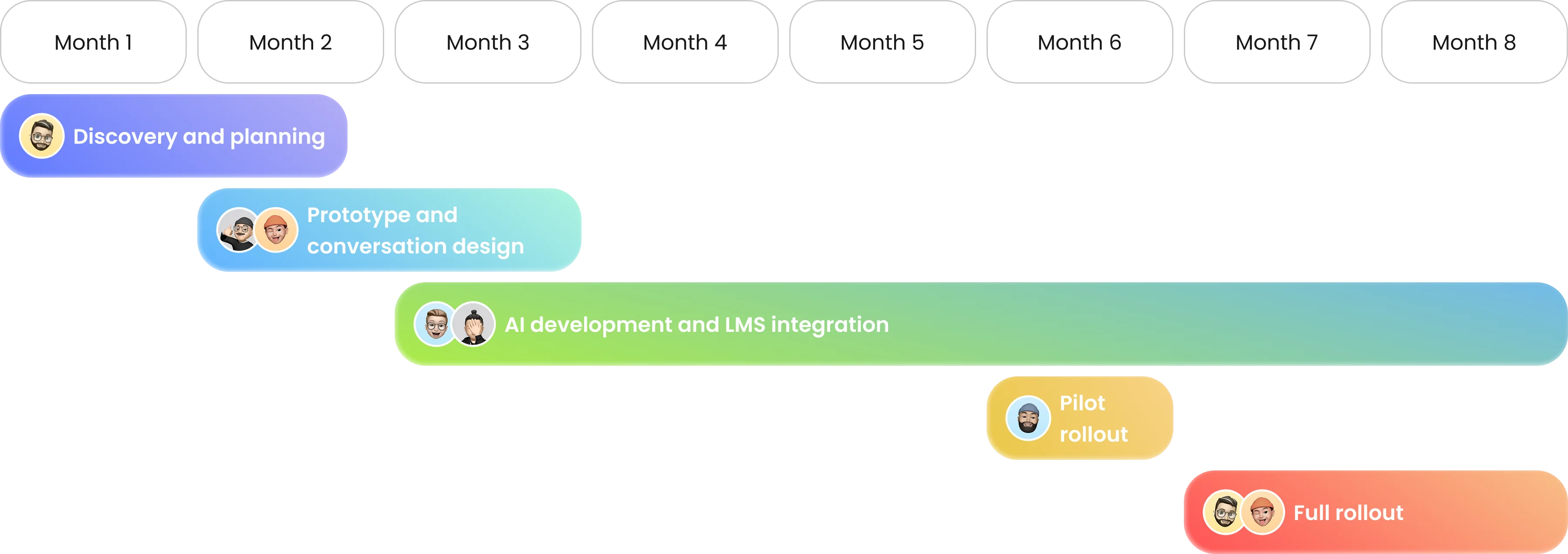
Development process
Project timeline
Key AI voice features
Here’s what the new voice assistant can do.
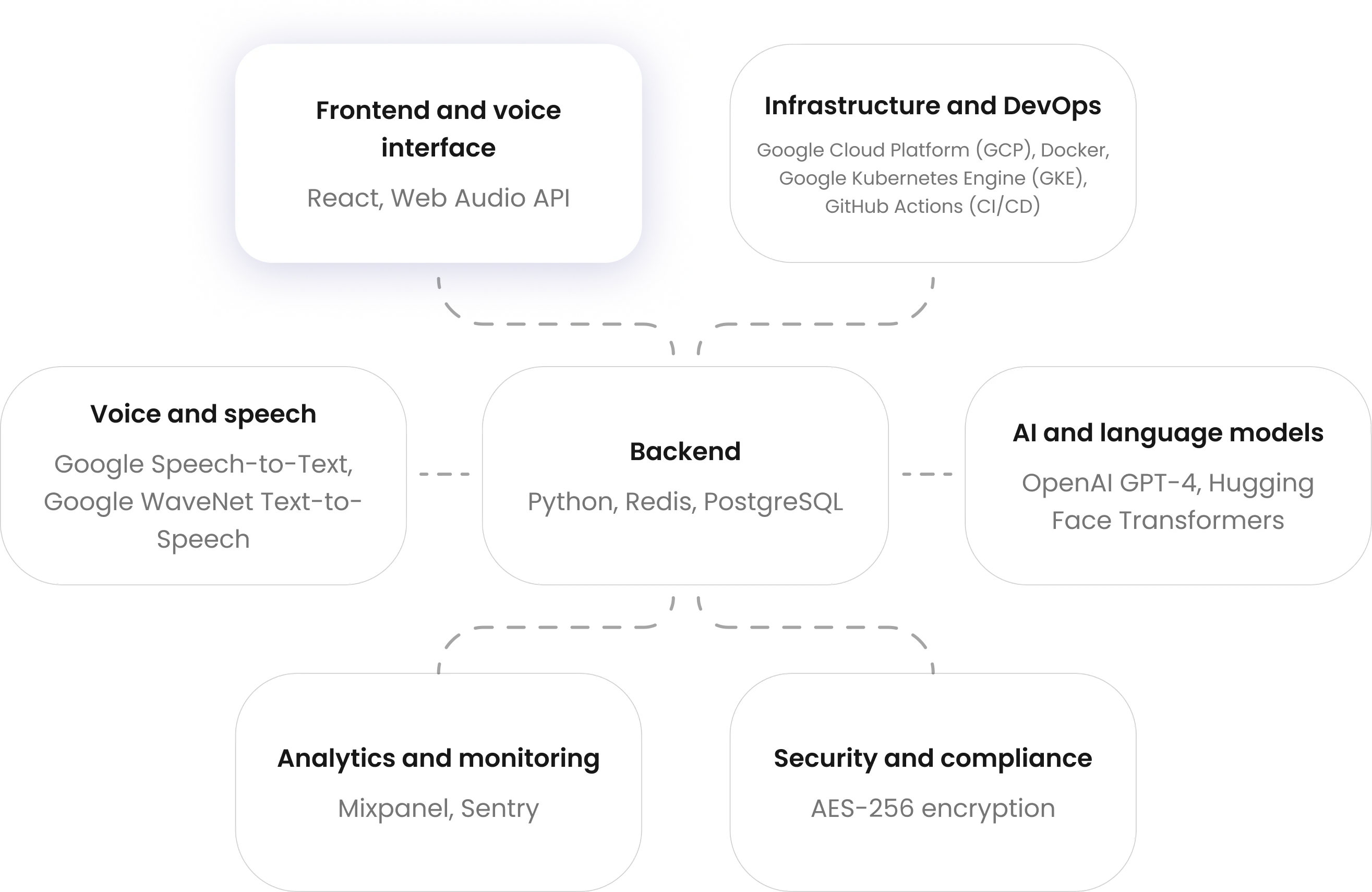
Tech stack
The technologies under the hood of the AI voice assistant:
Development challenges and solutions
What we faced during the development process.
Students ask the same question in many different ways
Challenge: Users sometimes say the same thing across different channels. Duplicates inflated cluster weights and caused noise in insights.
Solution: We trained the AI to recognize intent rather than exact wording. By combining structured intent detection with a language model trained on course material, the voice agent understands what the student means, not just what they say.

Maintaining context across longer learning sessions
Challenge: Unlike quick support queries, learning conversations often span entire lessons. Losing context leads to repetitive explanations and frustration.
Solution: Our team used unsupervised clustering (HDBSCAN + embeddings) so new topics would emerge naturally. We also enabled human curation: Product managers could rename clusters and map them to the internal product taxonomy.

Balancing automation with tutor control
Challenge: Fully automated learning support can be risky if it replaces tutor judgment or provides incomplete answers.
Solution: We designed clear escalation rules. When the AI detects uncertainty, repeated misunderstandings, or advanced questions, it hands the conversation over to a tutor along with full context.

Designing an accessible learning experience without relying on screens
Challenge: Many students couldn’t fully benefit from the platform’s existing learning experience.
Solution: We designed the learning experience around voice as one of the primary interaction methods, not an add-on. The AI voice agent allows students to navigate lessons, ask questions, and complete quizzes using natural speech alone.

Result
Increased student interaction by 40%
Reduced repetitive Q&A by 50%
Enabled hands-free learning for students with disabilities
Improved quiz and course completion rates by 20%

monthly cost.