- AI Transformation
- Services
- Works
Other projects
AI Learning PersonalizationSmart content recommendationsHotel AI ConciergeAI assistant for hotel guestsClaims Documentation AutomationPlatform for faster claims processingAI for Candidate ScreeningSmart HR efficiency boosterAI Voice AgentAI agent for hands-free learningLLM Legal SummarizationEfficient and fast legal summariesVision-Based Driving AssistanceReal-time threat detection system - Company
Yellow in Numbers
$2.1B+
Value generated through AI innovation47
Custom LLMs and AI agents deployed30M+
Engaging with products we created98%
Projects delivered within agreed budget


Key Takeaways
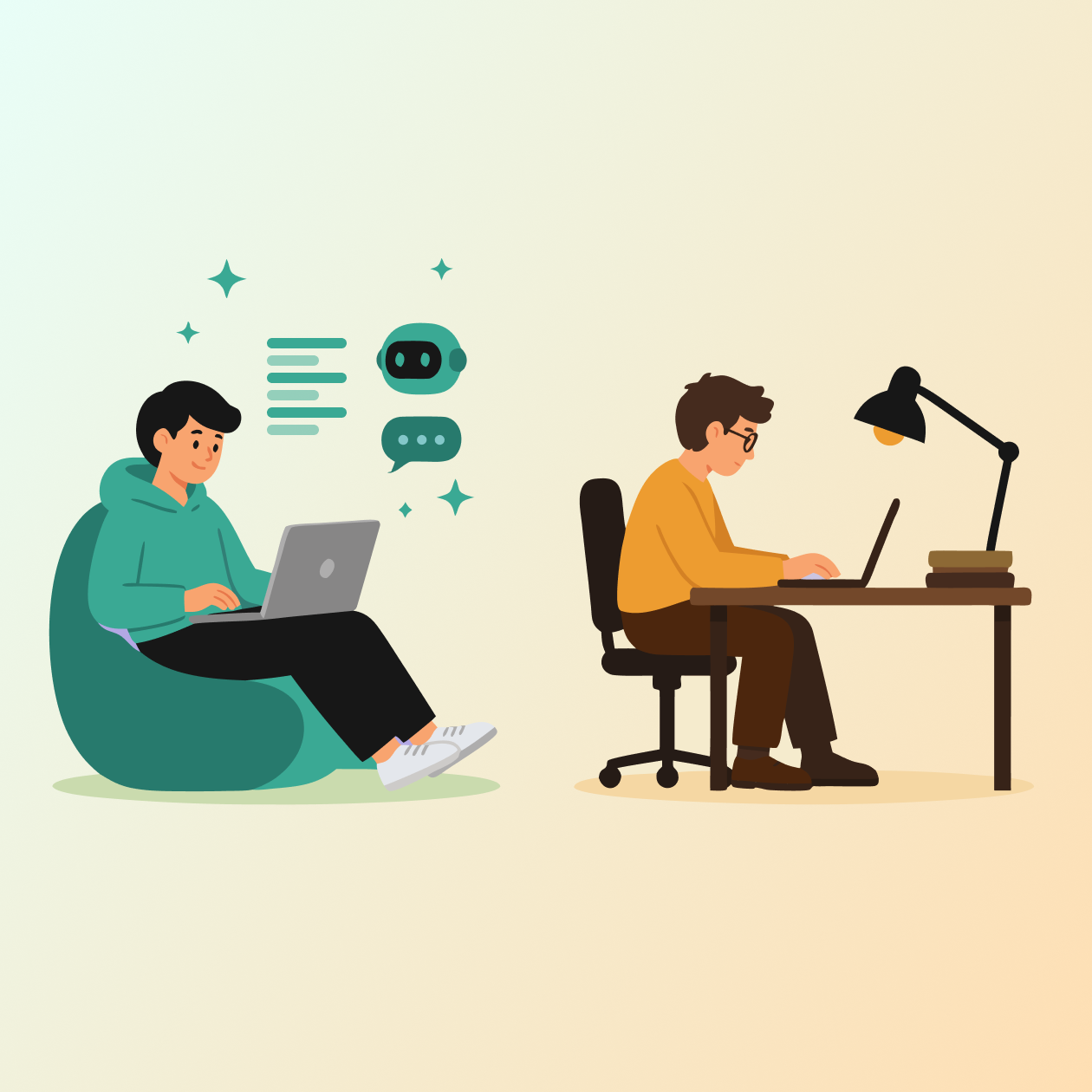
Vibe coding is an AI-first programming style where engineers (and non-engineers) describe what they want in whatever language they speak, then guide AI-generated code through prompts, reviews, and iterations.
Traditional software development gives engineers deeper control over architecture, security, debugging, and long-term maintainability.
The main difference in vibe coding vs traditional coding is how much responsibility you give to the engineer upfront versus how much you delegate to AI during creation.
Vibe coding works well for prototyping, internal tools, experiments, and early product validation.
Traditional development is still the safer choice for complex systems, regulated products, and anything where failure is expensive.
The best teams will likely combine both approaches instead of treating them like enemies.
Software development is changing in an interesting way these days. A few years ago, most engineers wrote every function by hand, searched documentation, copied a snippet or two, and slowly shaped the product through code. Now, an engineer can describe a feature in plain English and watch an AI tool generate a working first draft in seconds. That’s how vibe coding was born.
The term sounds casual, maybe too casual. It’s easy to understand why some engineers roll their eyes at it. It can sound like someone shipping production code based on “the vibes,” which is not exactly comforting if you care about security, uptime, or clean architecture. But the actual practice is more interesting than the name suggests. It doesn’t exclude traditional software engineers. They still guide the process, review the output, fix problems, and decide whether the generated code is good enough to keep.
So the real question is not whether vibe coding replaces the traditional one. It doesn’t. The better question is: When should you use each approach, and where does the line get risky?
Building AI-powered software and not sure where to start?
What Is Vibe Coding?
Vibe coding is an AI-first approach to writing code where an engineer uses natural language prompts to generate, modify, and refine code. Instead of starting with a blank file and writing every line manually, you explain what you want the software to do. The AI produces code, and you keep steering it until the result matches the goal.

In practice, vibe programming often looks like this: You ask an AI assistant to create a login page, generate an API endpoint, connect it to a database, or refactor a messy component. Then you inspect the result, adjust the prompt, run the code, find errors, and ask the AI to fix or improve specific parts.
This can be surprisingly productive. Still, it can also go sideways fast.
Vibe coding gives you speed, but it doesn’t magically give you judgment. If you don’t understand what the AI produced, you may accept code that works during a demo but fails under real-world pressure. That is where technical debt starts to sneak in. The kind you only notice later when a simple change breaks three unrelated things.
What Is Traditional Coding?
Well, we are all familiar with this one. Traditional coding is the standard software development approach where engineers write, structure, test, and maintain code directly. They still use libraries, frameworks, documentation, and sometimes AI copilots, but the main logic and implementation decisions come from human planning and manual programming.
Traditional development usually starts with understanding requirements. Then, engineers define architecture, write code, test it, debug it, deploy it, and maintain it over time. It’s slower than asking AI to generate a first draft, but it gives you more control. And plenty of times, control matters.
If you are building payment systems, healthcare tools, financial workflows, data infrastructure, or enterprise platforms, you need to know how the system behaves. You need predictable performance, constant security reviews, clean dependencies, clear ownership, and code that another engineer can understand six months later.
Traditional programming is not perfect. It can be slow, expensive, and prone to over-engineering. Still, it gives teams discipline. It forces decisions to be explicit. That makes it valuable when the stakes are high.
Vibe Coding vs Traditional Coding: Key Differences
The easiest way to compare these approaches is to look at how decisions are made.
In traditional development, the engineer controls the implementation from the beginning. They decide the structure, write the logic, test the edge cases, and manage the dependencies. AI may help, sure, but it does not lead the process.
In vibe coding, the engineer starts with intent. The AI generates a possible solution. The engineers then shape, correct, and validate it. That shift changes the rhythm of development. You move faster at the start, but you may spend more time reviewing and cleaning up later.
Here are the main differences:
| Area | Vibe coding | Traditional coding |
|---|---|---|
| Starting point | Natural language prompt | Manual design and implementation |
| Main strength | Speed and fast iteration | Control and reliability |
| Best fit | Prototypes, experiments, simple apps | Complex, secure, long-term systems |
| Risk | Hidden bugs, weak architecture, technical debt | Slower delivery, possible over-planning |
| Cost | Lower upfront cost for early builds, but cleanup costs can grow later | Higher upfront cost, but often more predictable over time |
| Developer role | Guide, reviewer, editor | Designer, builder, maintainer |
| Debugging | Often starts after the AI output fails | Usually built into the development process |
The comparison between vibe coding techniques vs traditional techniques is not as simple as “new versus old.” Vibe programming changes how quickly you can reach a working version. Traditional development changes how confidently you can support that version later. That distinction matters for business teams. A fast prototype is useful, but a breakable production system is not.
Moving from One to the Other
Teams don’t have to choose one approach forever. Moving between them can actually be the healthiest path.
A founder might use vibe coding to test an idea over a weekend. A product team might use it to create mockups, dashboards, or internal tools. If users respond well, engineers can then rebuild the most important parts with a stronger traditional development process.
The reverse also happens. A team with an existing codebase may use AI-assisted development to generate tests or explore refactoring options. In that case, vibe coding supports traditional development rather than replacing it.
The trick is being honest with yourself and understanding when the AI-generated version has reached its limit. If the code is becoming harder to reason about, if debugging feels like arguing with a wall, or if every new prompt creates new problems, it’s time to slow down and return to engineering basics.
Traditional Coding Process
We are going to dive a little deeper into how things actually work. Plenty of people are familiar with the basics of the software development process, but in order to have a fair comparison, let's revise the steps.

Planning and Requirements Gathering
Traditional software development usually starts with planning. The team defines what the product should do, who will use it, what limits exist, and how success will be measured.
This stage can feel slow, especially when everyone wants to “just build something,” but skipping it creates confusion later. Requirements help engineers avoid building the wrong thing. For business software, planning also covers security, compliance, integrations, user permissions, and performance needs. These details are boring, but they protect the product from expensive surprises.
Architecture and System Design
Architecture defines how the system is organized. It covers databases, APIs, services, infrastructure, data flows, and third-party integrations.
In traditional development, this stage is where engineers make long-term decisions. Should the product use a monolith or microservices? What authentication flow makes sense? How will the system scale? What should be logged? Where can the product potentially fail, and what should we do if (or when) it happens?
This is not the place to rely only on vibes. Good architecture makes future development easier. Bad architecture turns every new feature release into a small negotiation with past mistakes.
Manual Development and Testing
Manual development is where engineers write the actual code and test how it behaves. Testing includes unit tests, integration tests, security checks, code reviews, and manual QA.
Yes, it takes time. But this is also where deep understanding forms. Engineers notice edge cases, question assumptions, and catch weird interactions between systems.
Debugging is also more controlled in traditional programming because engineers usually understand why the code exists. They can trace the logic instead of trying to decode a large AI-generated block that nobody fully remembers approving.
Deployment and Maintenance
Deployment is not the finish line. Not even close. When you complete your first release, the real usage starts, and it brings a whole new set of surprises.
Traditional coding includes ongoing maintenance, monitoring, bug fixing, dependency updates, and performance improvements. Mature teams know that software changes after launch because users behave in ways nobody predicted. Always.
Maintenance is where traditional programming often proves its value. Clean structure, clear documentation, and tested logic make the product easier to support over time.
Vibe Coding Process
Now, let’s take a closer look at how vibe programming works. It has some similar parts, but the approach as a whole is different.
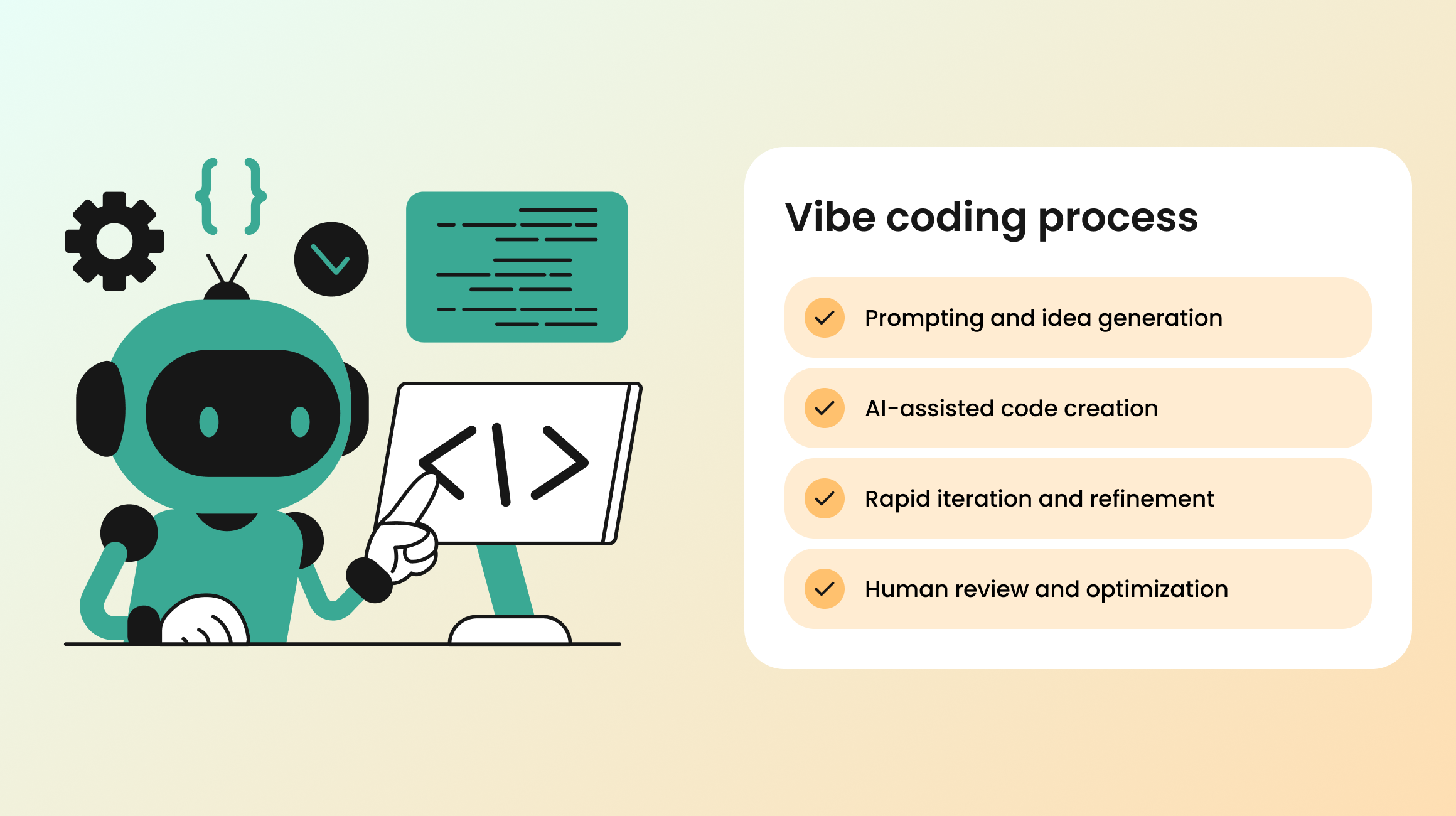
Prompting and Idea Generation
Vibe coding starts with a prompt. You describe what you want, often in plain language. The better the prompt, the better the first result usually is. A weak prompt might be: “Build a dashboard.” A stronger prompt might explain the user role, data fields, layout, framework, styling rules, and expected behavior. The AI still may not get everything right, but it has a better target.
This stage is useful for idea generation, too. You can ask for different implementation options, interface flows, or database structures. It can be hard not to get overwhelmed by the model’s speed and quality, but please don't give in to temptation. Judgment still matters.
AI-Assisted Code Creation
Once the prompt is clear, the AI generates code. This can include frontend components, backend routes, database queries, tests, scripts, or configuration files.
For teams working with generative AI, this step may also connect with broader AI product workflows, like prompt engineering, model integration, or automated content generation. For more advanced products, LLM development can help teams build custom language model features that go beyond simple code suggestions.
The benefit is obvious: speed. A task that might take an hour manually can produce a first version in a minute.
The downside is also obvious if you have been burned by it: The first version may look fine at first, but still be completely wrong.
Rapid Iteration and Refinement
Vibe coding shines during rapid iteration. You can ask the AI to adjust layouts, change logic, add validation, rewrite a function, or generate a different implementation, and you will see results in seconds.
This is great for prototyping. You can test ideas quickly without committing to a full build. Designers, founders, and product managers can see working versions earlier, which improves feedback.
But fast iteration can create messy layers. One prompt adds a workaround. Another prompt patches that workaround. Then a third prompt introduces a new dependency for no good reason. This is where technical debt grows.
Human Review and Optimization
Human review is the main difference between useful vibe coding and code generation for the sake of code generation.
An engineer should inspect the output, run tests, check security risks, remove unnecessary complexity, and make sure the code fits the larger system. If the AI created a clever solution that nobody on the team can maintain, it may not be a good solution.
For more advanced workflows, teams may combine code generation with AI agents that can inspect repositories, run tests, or suggest fixes. That can help, but again, someone still needs to own the final decision.
Our engineer shares practical tips for working with LLM-powered applications!
Read LLM application tipsWhen Do You Need Traditional Coding?
You need traditional development when the system is complex, sensitive, and expected to last. Choose this approach for:
Enterprise platforms with many integrations
Products with strict security requirements
Financial, healthcare, legal, or compliance-heavy systems
Core business infrastructure
High-load applications
Long-term products with multiple engineering teams
Traditional development is also better when architecture matters more than speed. If the system needs to scale, support multiple user roles, handle sensitive data, or integrate with legacy platforms, you want engineers making careful decisions from the start. AI can still help with test generation and code review, but the main approach should remain human-led.
When Does Vibe Coding Make Sense?
Vibe coding is especially useful for early prototypes, proof-of-concept builds, landing pages, internal admin panels, simple automation scripts, and experimental features. If the goal is to learn quickly, vibe coding can be a real advantage.
It also helps non-engineering teams communicate ideas. A product manager can create a rough working example instead of writing a long document nobody will read. A founder can test a workflow before hiring a full team. An engineer can explore several solutions before choosing one.
Still, if users depend on the feature, if money moves through it, or if private data is involved, vibe programming needs stricter review.
Can Vibe Coding and Traditional Coding Work Together?
Yes. The best workflow is often hybrid. Use vibe coding to explore ideas, write drafts, and move through repetitive tasks. Use traditional development to design architecture, apply security, review logic, and prepare everything for production.
This balanced approach gives teams the speed of AI-assisted development without losing engineering discipline. It also reduces waste. You don’t need a senior engineer to manually write every simple component from scratch. But you do need experienced engineers to decide whether the generated code belongs in the product.
The Future of Both Approaches
Vibe coding will improve. The tools will get better at understanding codebases, following project rules, writing tests, and catching mistakes. Some parts of software development will become much faster because of it.
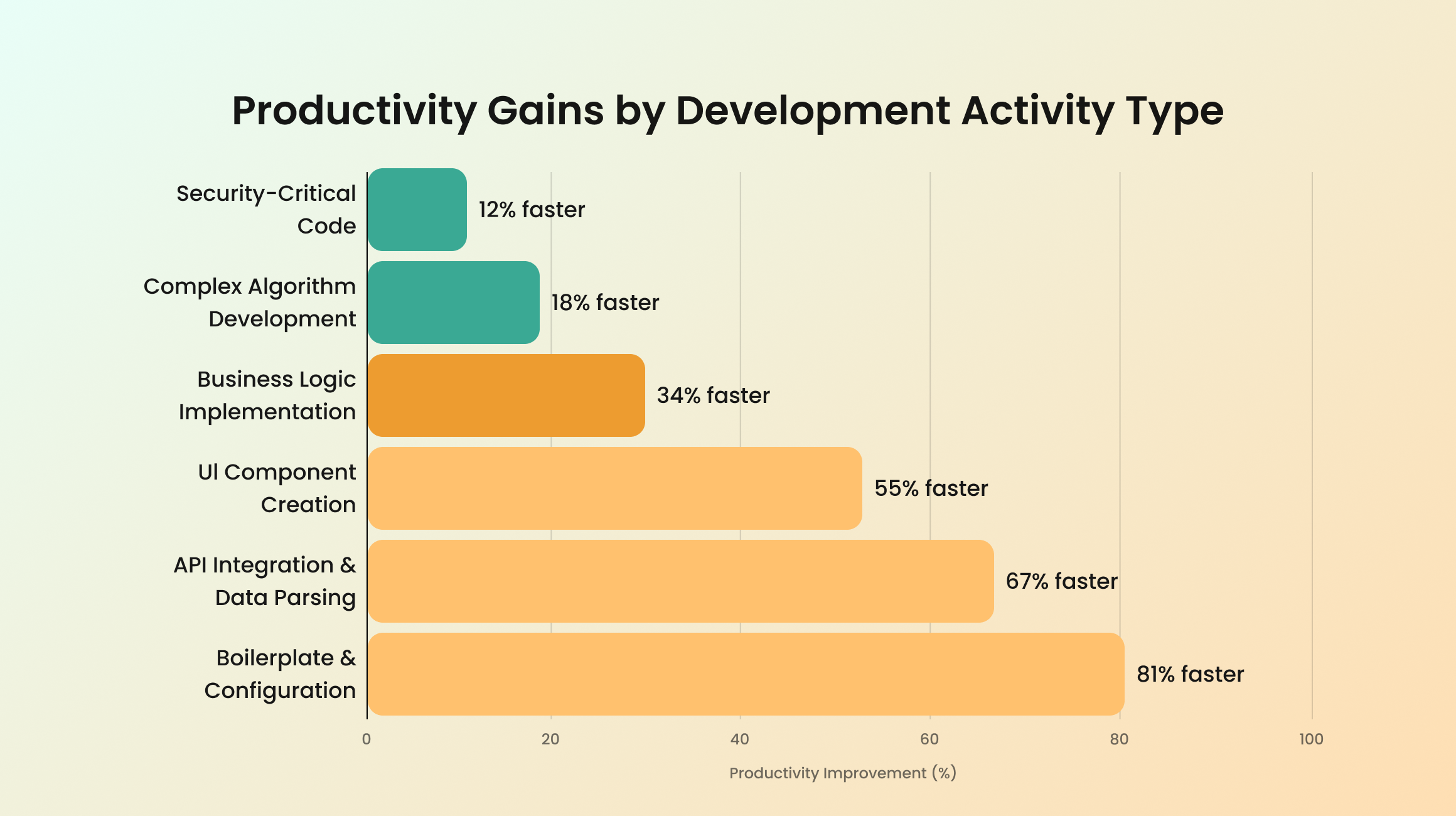
But traditional development is not going away. If anything, strong engineering judgment becomes more important when code is easier to generate. When anyone can create a working draft, the valuable skill shifts toward knowing what should be built, how it should be structured, and whether it is safe to ship.
Why Choose Yellow as Your AI Development Partner?
We help companies build practical AI products that can move from idea to production without falling apart in the middle. That includes AI-powered apps, workflow automation, LLM features, internal tools, and custom AI solutions designed around your business needs.
If you are exploring any type of AI product development, our team can help you validate an idea quickly, design a clean architecture from day one, and develop a full-scale solution that will be warmly received by your users and won't be a maintenance problem for next quarter.
Let’s discuss the right AI development approach for your product.
Conclusion
The debate around vibe coding vs traditional coding can get weirdly emotional. Some people treat vibe coding like the future of all programming. Others dismiss it as sloppy automation for people who don’t want to learn engineering. Both views miss the point.
Vibe coding is useful. Traditional coding is necessary. They solve different problems.
Use vibe coding when you need speed, exploration, and fast feedback. Use traditional coding when you need control, security, maintainability, and long-term reliability. Use both when you want to move quickly without pretending that AI-generated code is automatically production-ready. That balance is probably where modern software development is heading: A more flexible approach where engineers spend less time on repetitive coding and more time making good decisions.
Got a project in mind?
Fill in this form or send us an e-mail
What tools are commonly used for vibe coding?
Can beginners use vibe coding?
What skills are important for vibe coding?
What are the biggest risks of vibe coding?
Is vibe coding suitable for enterprise software development?
Subscribe to new posts.
Get weekly updates on the newest design stories, case studies and tips right in your mailbox.