Claude Sonnet-Based Operating System for Commercial Real Estate
A Claude Sonnet-powered leasing operations platform that turns data into business value

About the project
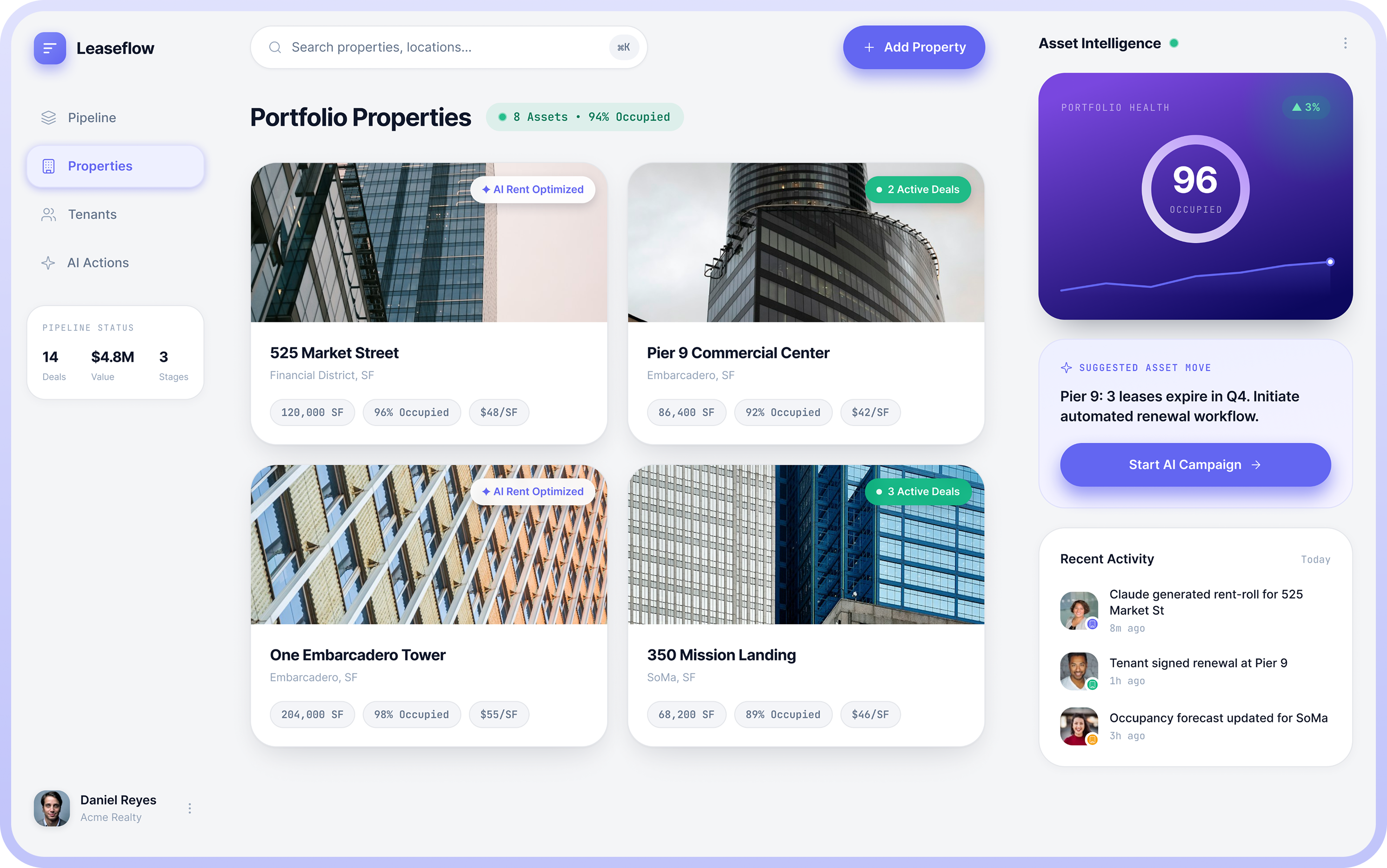
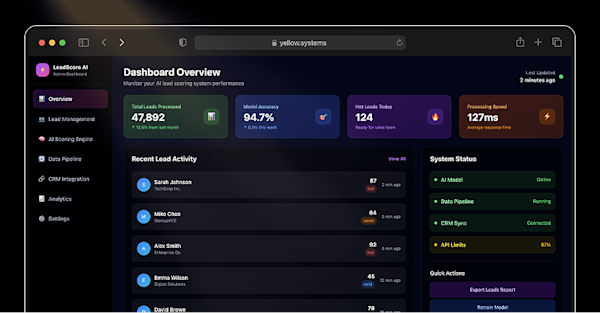
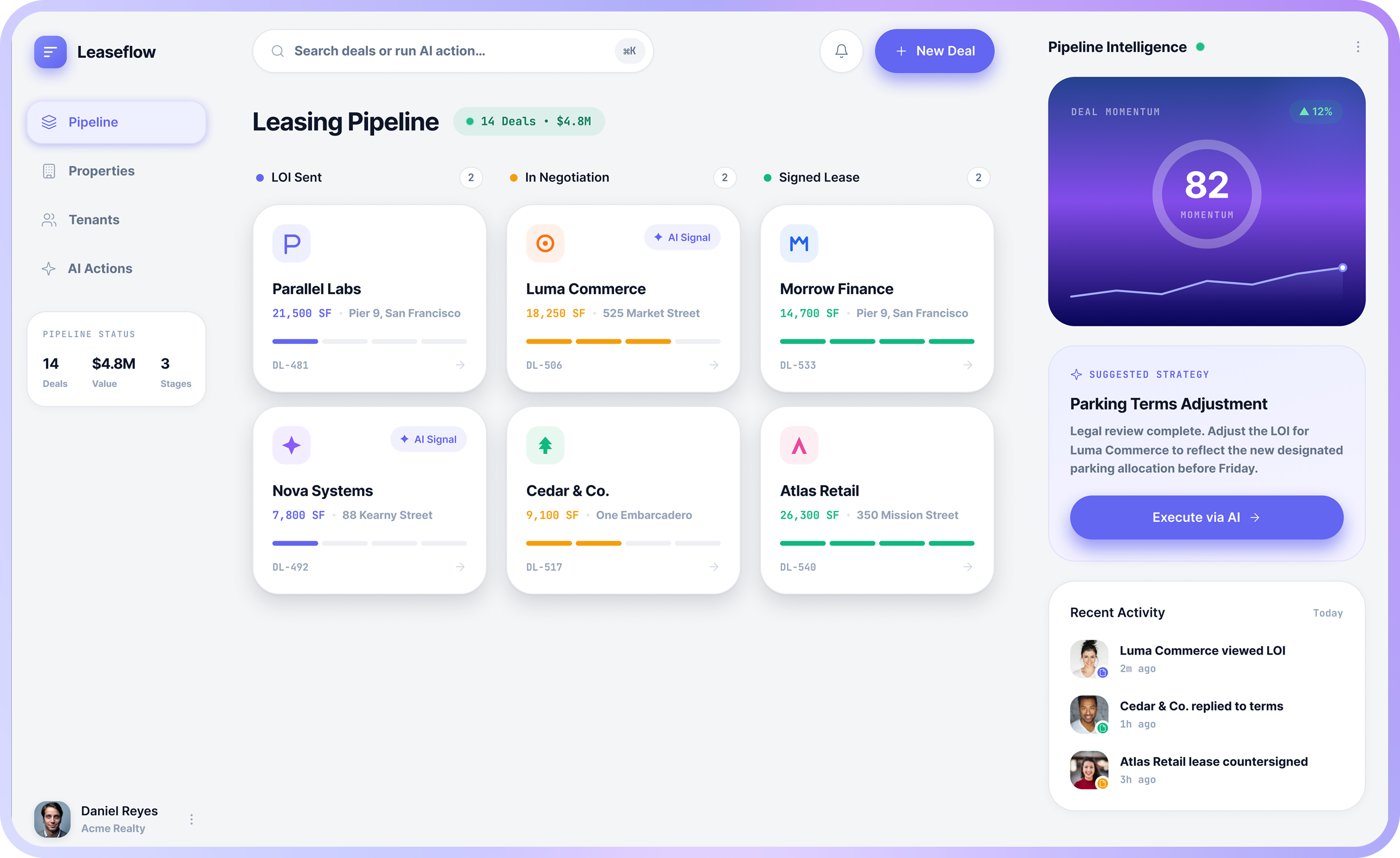
Our client manages a portfolio of commercial office and mixed-use properties. As the portfolio grew, leasing teams spent more time searching through CRM records, spreadsheets, and documents than actually moving deals forward. Yellow built and operated an AI-native platform powered by Anthropic’s Claude Sonnet to help the existing team scale without adding headcount. Claude acts as a reasoning layer across the leasing process, assessing opportunities, recommending next actions, and automating routine administrative work.
The client had
Hundreds of active leasing opportunities across a portfolio of commercial properties
Leasing information spread across CRM records, emails, spreadsheets, lease documents, and broker conversations
Significant manual effort spent preparing updates/maintaining records
Inconsistent follow-up processes across teams
Growing administrative workload as the property portfolio expanded
We were responsible for
Designing the AI-native leasing operations architecture
Integrating Sonnet with existing leasing and property management systems
Building a context layer combining tenant, property, broker, and lease data
Developing AI workflows for opportunity analysis and lease risk detection
Creating agentic workflows for leasing operations
Implementing governance and approval mechanisms

Team
To achieve all the goals, we combined the following professionals:
Senior engineers remained responsible for architecture, technical decisions, and production quality, while AI agents were given bounded tasks and operated under continuous human supervision.

Why Claude Sonnet?
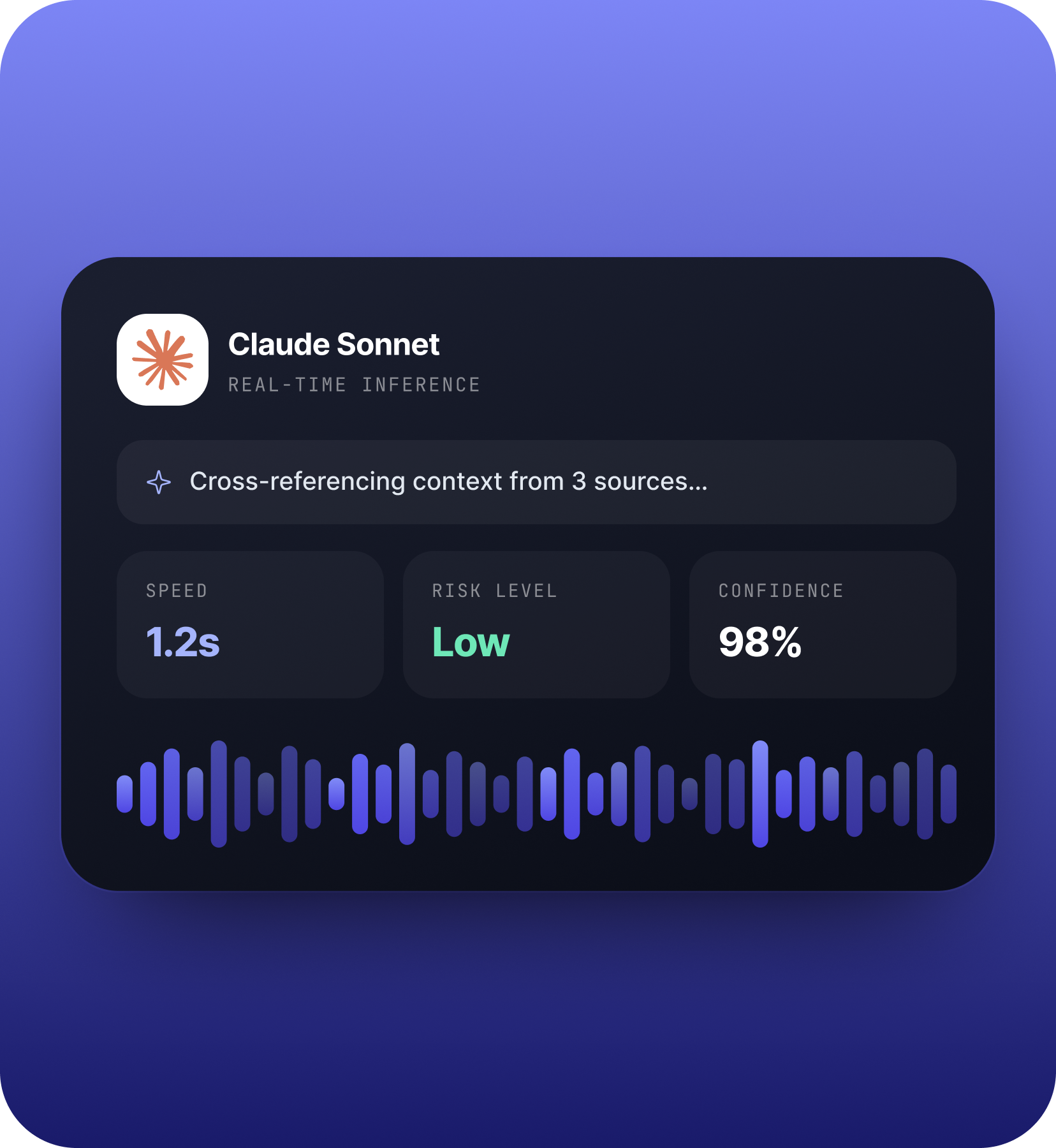
Leasing decisions depend on context spread across emails, CRM records, property data, documents, and ongoing negotiations. Claude Sonnet became the reasoning layer that brought this context together to assess opportunities, detect risks, recommend next actions, and support controlled workflow execution. For a multi-agent system running across a high volume of leasing workflows, Sonnet offered the right balance of reasoning capability, speed, and cost. Combined with Yellow's evaluation, governance, and human-in-the-loop framework, Claude Sonnet enabled the client to move from isolated AI features to an AI-native leasing operation.
The development process
Here’s a short overview of the strategy we used to build the final solution.
Discovery & workflow analysis
We analyzed the client's leasing process, identified operational bottlenecks, and found workflows where AI could reduce administrative overhead and improve decision-making.
Context architecture
We connected the client's CRM, property management systems, lease databases, email channels, broker communications, and portfolio data into a unified context layer that Claude Sonnet could use for reasoning.
Leasing intelligence layer
We implemented Sonnet-powered workflows capable of opportunity assessment, lease risk detection, tenant relationship analysis, next-best-action recommendations, and property pipeline monitoring.
Agentic operations
The platform was connected to operational systems, allowing Claude Sonnet to update CRM records, create follow-up tasks, prepare summaries, and draft tenant and broker communications. Actions with business impact required approval before execution.
AI evaluation & governance
We created evaluation datasets based on historical leasing scenarios and implemented automated testing to measure recommendation quality, accuracy, and compliance with business rules.
Production rollout
The platform was introduced in stages, beginning with recommendations and intelligence features before expanding into operational automation.
Project timeline

Discovery & architecture
Week 1-2

Data & context layer
Weeks 2–4

Sonnet-powered leasing intelligence implementation
Weeks 3–6

Agent workflows
Weeks 5–6

Evaluation framework, governance controls, observability
Weeks 5–7

Production rollout
Weeks 7–8
Key AI features
The platform was built around several practical use cases.
AI-Native Operating Model
At the core of the platform is a structured operating model that enabled the client to move beyond isolated AI features and establish an AI-native leasing operation:
Property & tenant data
Context layer
Claude Sonnet reasoning
Recommendations
Actions
Evaluation
Continuous improvement

Tech stack
Technologies we used to build the platform:
Development challenges and solutions
Challenges we faced during the development process.
Lack of historical conversion labels
Challenge: Leasing information was fragmented across multiple systems, making it difficult to maintain a complete and accurate view of opportunities.
Solution: We created a unified context architecture that aggregated property, tenant, broker, and leasing information into a structured format optimized for Claude Sonnet.
CRM integration constraints and limitations
Challenge: Business-critical workflows require clear operational boundaries for AI.
Solution: We established a governance framework defining which actions Sonnet could observe, recommend, prepare, or execute autonomously.
Result
Within four months of going into production, the client achieved:
35%
reduction in administrative work
33%
faster follow-up on active leasing opportunities
18%
reduction in stalled negotiations
Beyond the numbers, they now have a leasing operation that can absorb portfolio growth without a matching jump in headcount.